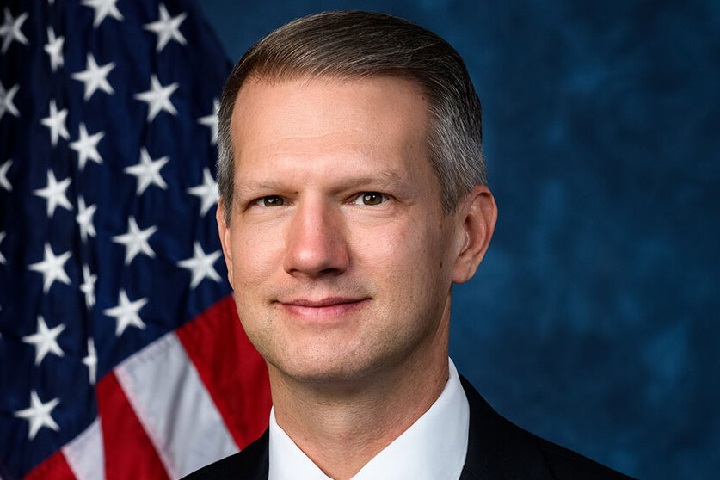
United States Congressman Riley Moore has sounded the alarm over what he described as a “genocide” against Christians in Nigeria’s Middle Belt.

Congressman Moore raised the alarm in an interview while appearing on FOX News after a fact‑finding mission to Benue State and surrounding areas.
Moore recounted harrowing testimonies from survivors and eyewitnesses.
He warned that the U.S. government may consider sanctions or even military action on Nigeria if the killings persist.
Fact-Finding Mission
Moore, who represents West Virginia, led a congressional delegation to Nigeria in late 2025. The mission was aimed at investigating reports of mass killings and displacement of Christian communities by Islamist extremist groups, particularly Fulani militants.
During his visit, Moore met with bishops, traditional leaders, and survivors in Internally Displaced Persons (IDP) camps. He reported that more than 600,000 Christians are currently living in camps in Benue State alone, many in dire conditions without adequate food, shelter, or medical care.
Survivor Testimonies
In his FOX News interview, Moore shared disturbing accounts from survivors. One woman told him she was forced to watch as her five children were killed during an attack on her village. Others described homes burned, farmland destroyed, and communities terrorized by armed groups.
“These stories will stay with me for the rest of my life,” Moore said. “What I saw and heard in Nigeria is unlike anything I have ever experienced. This is genocide.”
Accusations Against Nigerian Authorities
Moore accused the Nigerian government of failing to protect vulnerable communities and downplaying the scale of the crisis. He argued that official narratives often frame the violence as communal clashes, while in reality, organized extremist groups are systematically targeting Christians.
“The Nigerian government has ignored this genocide,” Moore told FOX News. “They have not acted to stop it, and the world cannot remain silent.”
U.S. Policy Implications
Moore revealed that he would deliver a detailed report to President Donald Trump outlining the findings of his mission. He said the President had directed him to lead the investigation and was prepared to act.
“All options are on the table,” Moore stated, adding that measures could include sanctions against Nigerian officials or even kinetic military action if the killings continue. He emphasized that the U.S. would seek to work with Nigeria’s government but warned that inaction would not be tolerated.
International Reactions
The Congressman’s remarks have intensified global attention on Nigeria’s Middle Belt crisis. Human rights organizations have long documented attacks on Christian communities, but Moore’s testimony adds weight to calls for stronger international intervention.
Critics caution that framing the violence as genocide could inflame tensions and complicate diplomatic relations. Nigerian officials have historically rejected such characterizations, insisting that the conflict is rooted in competition over land and resources.
Supporters of Moore’s position argue that the scale and targeting of Christian communities meet the threshold for genocide under international law. They say the U.S. must act decisively to prevent further atrocities.
Broader Context
Nigeria’s Middle Belt has been plagued by violence for decades, with clashes between herders and farmers often escalating into deadly attacks. In recent years, extremist groups have exploited these tensions, leading to mass displacement and widespread insecurity.
The crisis has drawn comparisons to other humanitarian emergencies, with observers warning that failure to address it could destabilize Nigeria and the wider West African region.
Conclusion
Congressman Riley Moore’s FOX News interview has brought renewed urgency to the plight of Christians in Nigeria’s Middle Belt. His firsthand accounts of atrocities, combined with warnings of possible U.S. sanctions or military action, underscore the gravity of the situation.
As Moore prepares to deliver his report to President Trump, the international community faces a critical question: will Nigeria and its partners act to end the violence, or will the killings continue unchecked?