
THIS DAWN — Former Aviation Minister Osita Chidoka has strongly rejected the Master’s thesis that claims statistical and machine-learning analysis reveals widespread manipulation in the South-East.

His rejection sparked a new controversy over Nigeria’s 2023 presidential election.
Chidoka argued that its conclusions misinterpret identity-driven voting patterns and fail to account for institutional safeguards introduced in recent electoral reforms.
The Thesis and Its Allegations
The thesis, Applying Machine Learning Techniques to Detect Electoral Fraud in Nigeria’s 2023 Elections, was prepared by Joachim Oye MacEbong.
MacEbong applied statistical forensics such as Benford’s Law, last-digit tests, and unsupervised machine learning models to polling-unit results.
He concludes that anomalies in the South-East point to inflated votes for dominant parties, suggesting manipulation at scale.
The work has gained traction online, sparking heated discussions about whether advanced statistical tools can uncover fraud in Nigeria’s elections.
Chidoka Responds: “Statistics Misread Democracy”
In a detailed essay shared on X, Chidoka acknowledged the thesis as genuine but warned that its conclusions “exceed what the evidence can sustain.”
He stressed that while statistical tools can highlight unusual patterns, they cannot replace ground truth evidence provided by Nigeria’s Bimodal Voter Accreditation System (BVAS).
“The primary integrity test in the BVAS era is simple and decisive: votes cast must not exceed BVAS-accredited voters at the polling unit.
“Any credible claim of ballot manipulation must begin at the polling unit,” Chidoka wrote.
He argued that analyses relying solely on anomaly detection risk producing false positives.
This is especially so in identity-driven democracies where voting patterns are highly clustered and politically intelligible but statistically “odd.”
Historical Context: Cohesion in Southeast Voting
Chidoka placed the South-East’s 2023 results within a broader historical trajectory:
- 2011: ~98% for Goodluck Jonathan
- 2015: ~88% for PDP; North-West ~81% for Buhari
- 2019: ~81% against Buhari
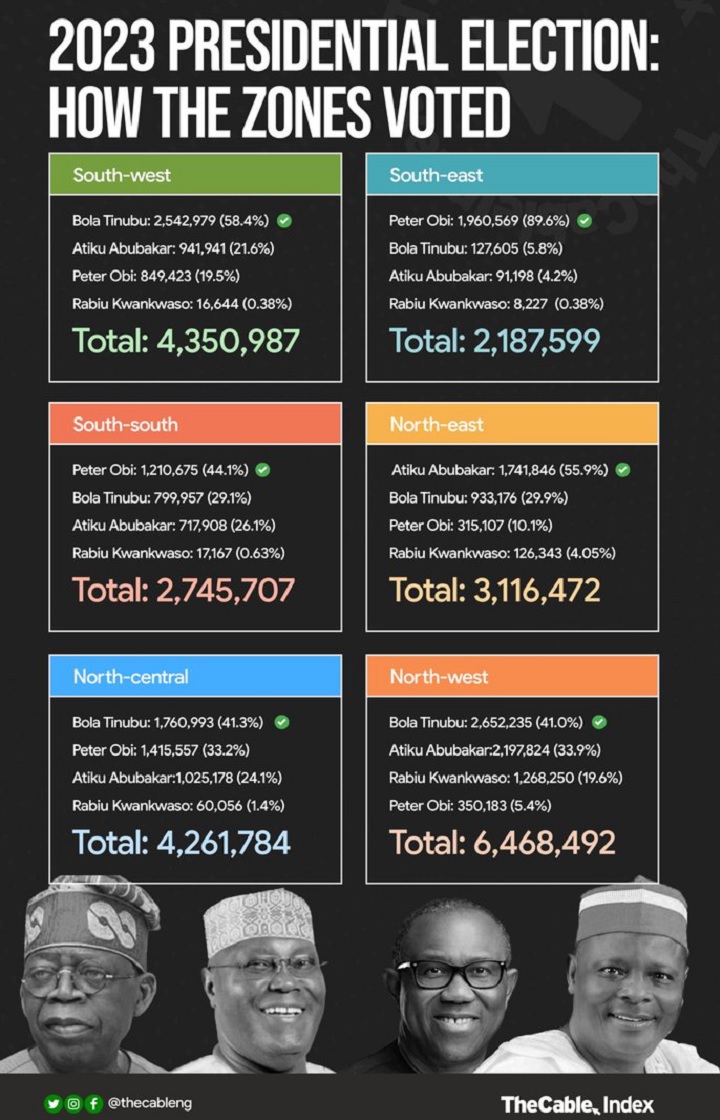
- 2023: ~90% for Labour’s Peter Obi
He noted that these results reflect consistent identity-anchored mobilisation, not fraud.
“2023 is not an anomaly. It is consistent with history,” he argued.
He pointed out that similar bloc voting occurred in the North-West for Buhari in 2011 and 2015, and in the South-West for AD/APP in 1999.
Limits of Machine Learning in Elections
Chidoka cautioned that machine learning models detect outliers, not illegality.
Outliers can arise from ethnic homogeneity, youth-driven protest voting, or urban–rural turnout asymmetries.
Without corroboration from BVAS records, cancellations, or incident reports, translating anomalies into fraud claims is “an epistemic leap the data does not permit.”
From his work at the Athena Centre, Chidoka noted that manipulation exists but is limited to under 20% of polling units.
Identifying those requires institutional evidence, not statistical shape alone.
Public Reactions to Chidoka
The essay has triggered diverse reactions across social media:
- @mikolysis21 argued that the fraud narrative is a pre-emptive strategy:
“They are trying hard to create a narrative to discredit the South-East vote. This is a calculative attempt for 2027. I understand their game.”
- @jononyes dismissed the fraud claims outright:
“No need to analyse any data that suggested that 2023 election was manipulated in SE for Labour. Manipulated by who? Machine learning nonsense!”
- @elostann supported Chidoka’s historical framing:
“The South-East’s voting pattern is not new. Obi’s 90% is no different from Jonathan’s 98% in 2011. History matters.”
- @nomalyzed offered a balanced view:
“Both sides are right. BVAS is a safeguard, but data science should complement—not replace—ground truth.”
These reactions underscore the tension between technocratic analysis and political sociology in interpreting Nigeria’s elections.
Implications for Nigeria’s Democracy
The controversy highlights a broader challenge: how to integrate advanced analytics into electoral scrutiny without misreading identity-driven democracies.
Chidoka insists that Nigeria’s democracy requires better questions, grounded methods, and historical sense, rather than overreliance on statistical anomalies.
“The 2023 election deserves scrutiny. It does not deserve conclusions that outrun the evidence.
“When statistics misread democracy, the remedy is not less data but better questions,” he wrote.
His intervention suggests that while Nigeria must embrace data-driven oversight, it must also respect institutional reforms like BVAS and the sociological realities of its electorate.
The clash between MacEbong’s thesis and Chidoka’s rebuttal illustrates the evolving landscape of electoral analysis in Nigeria.
Data science offers powerful tools, but identity politics and institutional safeguards remain decisive.
As Nigeria prepares for future elections, the challenge will be balancing statistical innovation with political realities—ensuring that numbers illuminate democracy without distorting it.