THIS DAWN — A New York Times investigation has ignited a storm of debate in Nigeria and abroad after describing prominent activist Emeka Umeagbalasi as a “screwdriver salesman” and publishing a disputed photograph that critics say misrepresents his background.

In a brazen display of journalistic malpractice, the New York Times’ January 18, 2026, investigation titled “How a Screwdriver Salesman Helped Fuel U.S. Airstrikes in Nigeria” appears to be little more than a calculated effort at image laundering for the Tinubu administration.
The publication is timed suspiciously after Nigeria’s $9 million lobbying contract with the U.S.-based DCI Group—signed in December 2025 to “communicate” the government’s supposed efforts to protect Christians.
The piece was evidently contrived to smear Umeagbalasi, is a respected criminologist and founder of the International Society for Civil Liberties and the Rule of Law (Intersociety).
The NYT report was so base as describing Umeagbalasi as an unreliable “screwdriver salesman” peddling “spotty” research.
Far from objective reporting, the article amplifies a narrative that downplays Nigeria’s complex security crisis, aligning conveniently with the lobbying deal’s goal to counter claims of targeted Christian persecution and avert further U.S. intervention under President Trump.
The Controversial Photograph
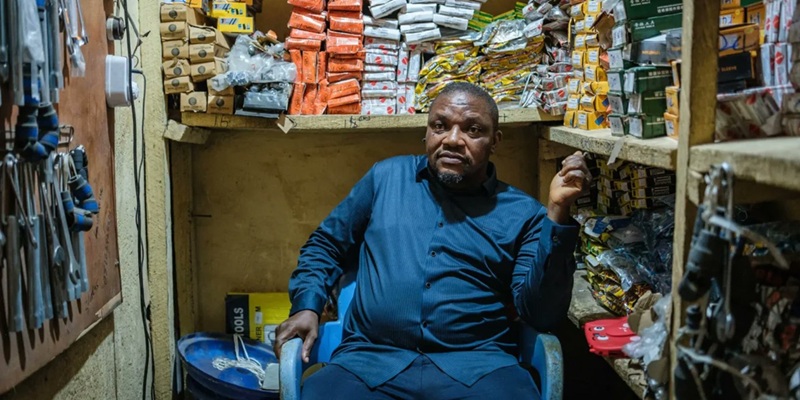
The article featured an image credited to Lagos-based photographer Taiwo Aina.
The photo shows Umeagbalasi seated in a cramped space surrounded by tools and hardware items.
The article claimed he owned “a tiny shop selling screwdrivers and wrenches in this market in Onitsha.”

Local traders familiar with Onitsha Main Market, West Africa’s largest trading hub, noted that the image did not match identifiable stalls in the hardware sections.
Public records also list Umeagbalasi’s NGO, Intersociety, at 41 Miss Elems Street in Fegge, Onitsha, where he operates primarily from his home.
Allegations of Misrepresentation
Social media commentators and Nigerian observers accused the New York Times of attempting to discredit Umeagbalasi by portraying him as a low-level trader rather than a respected activist.
Some speculated the photo might be digitally altered or AI-generated.
Umeagbalasi, a criminologist with advanced degrees in security studies and peace/conflict resolution, has led Intersociety in documenting violence against Christians in Nigeria.
His reports claim over 125,000 Christian deaths since 2009, figures that have influenced U.S. foreign policy.
Republican lawmakers including Senator Ted Cruz and Representative Chris Smith have cited his data in congressional hearings.
These reports contributed to President Donald Trump’s 2025 redesignation of Nigeria as a Country of Particular Concern (CPC) for religious freedom, a move followed by U.S. airstrikes on ISIS targets in Sokoto on Christmas Day 2025.
Critics and Counter-Narratives
The New York Times article quoted analysts from the International Crisis Group, who described Umeagbalasi’s data as “spotty.”
They argued that Nigeria’s violence stems from multiple sources — banditry, herder-farmer clashes, and jihadist attacks — affecting both Christians and Muslims.
Umeagbalasi has previously defended his methodology, citing difficulties in on-site verification due to insecurity.
Advocacy groups such as Truth Nigeria argue his figures may even understate the scale of killings, given access challenges in conflict zones.
Timing and Political Context
The publication’s timing has raised suspicions of political motives.
In December 2025, Nigeria’s National Security Adviser Nuhu Ribadu signed a $9 million lobbying contract with U.S. firm DCI Group to reshape narratives in Washington.
Opposition figures, including Omoyele Sowore of the African Action Congress, labeled the NYT piece a “coordinated smear”.
They suggest it aligns with government efforts to counter persecution claims ahead of the 2027 elections.
Independent data from the Armed Conflict Location and Event Data Project (ACLED) reported over 6,700 civilian deaths in Nigeria in the first half of 2025, with significant impacts in Christian-majority regions such as the Middle Belt.
NYT Response and Fallout
The New York Times declined immediate comment on the photo controversy but insisted its reporting adheres to verification standards.
Umeagbalasi has not yet publicly responded.
The debate underscores the difficulty of documenting Nigeria’s complex security crisis, where narratives are often polarized and international policy decisions hinge on contested data.
The controversy over the New York Times’ portrayal of Emeka Umeagbalasi highlights the intersection of journalism, activism, and geopolitics.
Whether the disputed photograph was miscaptioned, staged, or simply misunderstood, the fallout reveals how imagery and framing can shape perceptions of credibility.
As Nigeria grapples with violence and prepares for future elections, the case raises broader questions about media responsibility, lobbying influence, and the struggle to present an accurate picture of one of Africa’s most volatile conflicts.