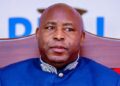
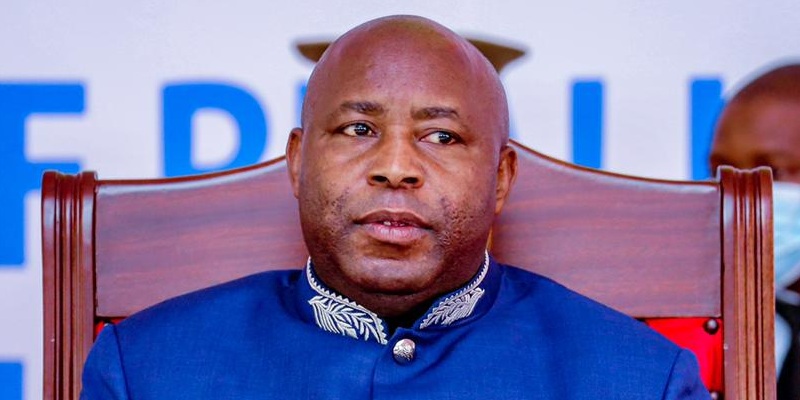
TDWhen Burundi’s tenth President, Évariste Ndayishimiye, 57, was elected Chairperson of the African Union (AU) last February, many political commentators paid little attention.

It was only for one year and a routine rotational position of limited significance.
The former military rebel leader is now using the position for self-aggrandizement, rubbishing his country, which gained political independence before his birth.
He attracted international infamy to Africa’s foremost political body, a successor to the Organisation of African Unity (OAU), formed in 1963, and which fought for the liberation of African countries.
Despite Ndayishimiye’s promises of reform, “Burundi remains a nation plagued by human rights violations, political repression, and a culture of impunity.
Reports from Amnesty International, Human Rights Watch, and the United Nations cite continued atrocities, including extrajudicial killings, enforced disappearances, sexual violence, and severe restrictions on civil society and the media.”
Ndayishimiye has hogged the spotlight and brought public scrutiny upon himself, for all the wrong reasons, over his scandalous and non-procedural attempt to make former Senegalese President Macky Sall, a man with unsavoury political baggage, the AU candidate for the United Nations Secretary General’s position through the “backdoor.”
According to diplomatic sources, the Permanent Mission of Burundi to the UN in New York, in a Letter dated 2 March 2026, addressed to the Presidents of the UN General Assembly and the UN Security Council, said that Sall had been nominated as a candidate for the UN’s top job.
The letter read in part:
“…my government, current Chair of the African Union, nominates His Excellency Macky Sall, former President of the Republic of Senegal, for the position of Secretary-General of the United Nations.”
This came as a surprise to the diplomatic World and many African heads of state and government, who were not consulted before this important decision.
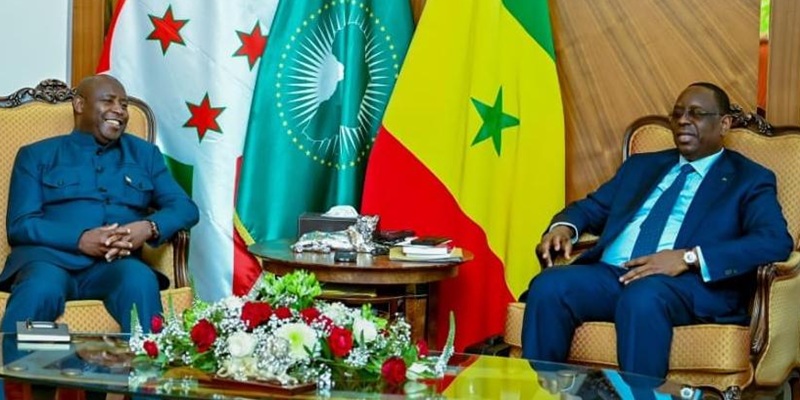
To further compound the situation, President Ndayishimiye himself was reported to have attempted to force the hands of his colleagues to approve Sall’s nomination in flagrant violation of the AU procedure.
This he did by convening a poorly attended meeting, giving member states a “24-hour silence response” to rubber-stamp Sall’s nomination for the UN top job.
This has elicited outrage, with Nigeria and Senegal, Sall’s country, among AU member states that have taken strong exception to the diplomatic travesty and distanced themselves from the Burundi President’s plot.
Sall was Chairperson of the AU from 2022-2023.
He and Ndayishimiye cannot claim ignorance of the AU’s time-honoured tradition and procedure for the nomination of candidates to represent Africa in international organisations.
The Burundi Permanent Representative, by writing to the UN in the name of the AU without prior consultation, and Ndayishimiye, to bend the rule by convening a kangaroo meeting for a fait accompli, is a slap in the face for Africa, by a leadership arrogance that must be purged.
A continental organisation cannot be run as a personal fiefdom.
Furthermore, under an unwritten agreement by the continents at the UN, it is Latin America’s turn to produce the next UN Secretary General.
Two prominent Africans – Boutros Boutros-Ghali of Egypt, and Ghana’s Kofi Annan, had served the world body in that capacity without controversy.
By breaking a standing accord at an international forum, Africa will make itself vulnerable and untrustworthy.
Despite the failed attempt to con the AU, Sall and his supporters are doubling down in pursuit of the UN top job.
While it may be within his rights to pursue an ambition, he must earn or obtain official approval to represent Africa at an international organisation.
Denying Senegal’s possible accomplice in the plot, the country’s Foreign Minister Cheikh Niang has told the local press that Sall’s UN candidature was not submitted by Senegal, which “was not involved in the process”.
Also, to democracy advocates and his opponents, Sall should not represent Africa in an international organisation like the UN, given his political baggage and alleged atrocities committed, especially towards the end of his term of office.
Sall had opposed the third-term plan of his predecessor, former President Abdoulaye Wade, but was prevented by Senegal’s resilient electorate from perpetuating himself in office.
At a press conference in Dakar last week, Pape Abdoulaye Touré of the “Families of Martyrs Collective” accused Sall of “attempting to take refuge at the UN to escape prosecution,” adding that “he does not deserve to be the UN Secretary General.”
Similarly, a Senegalese ruling party MP, Guy Marius, said: “We cannot accept that the UN be a ‘laundering facility’ for crimes of bloodshed and economic crimes.”
For the record, Ndayishimiye is among a few leaders, if not the only one, whose inauguration in June 2020 was not attended by any foreign leader.
The COVID-19 pandemic was cited as the reason, but his role in the unfolding scandal speaks volumes.
A former rebel military leader from the Hutu tribe, he began studying law at the University of Burundi in Bujumbura, but his education was cut short in 1995 because of the inter-ethnic violence that targeted Hutu students during the Burundian civil war (1993-2006).
Ndayishimiye joined the moderate rebel group, the National Council for the Defence of Democracy – Forces for the Defence of Democracy or Conseil National Pour la Défense de la Démocratie – Forces pour la Defense de la Démocratie, (CNDD–FDD), which was supported mainly by the Hutu population.
After the war, the CNDD-FDD fighters were integrated into the Burundian Army, with Ndayishimiye rising through the ranks and holding senior positions such as Chief of Staff for Human Resource Management and Quartermaster.
When the CNDD-FDD morphed into a political party in 2003, Ndayishimiye served as Minister of Interior and Public Security (2006-2007) and later became Chief of Military Cabinet to President Pierre Nkurunziza.
He held the position until 2024, when he also obtained a degree from Burundi’s Wisdom University of Africa, and chaired his country’s National Olympic Committee.
In 2018, Nkurunziza said he would not seek a fourth term and endorsed Ndayishimiye as the CNDD-FDD’s candidate for the May 2020 presidential election.
Ndayishimiye claimed victory with about 68% of the vote for a seven-year initial mandate, although the opposition alleged that the election was flawed with irregularities.
Nkurunziza was due to step down in August 2020; however, due to his sudden death in June, Ndayishimiye was sworn into office earlier than scheduled, even though under Burundi’s 2018 Constitution, “the Vice President of the Republic carries out the management of standard affairs” in the event of the death or absence of the elected president.
Nkurunziza reportedly died from COVID complications, so attendees of Ndayishimiye’s inauguration were told to arrive early for the coronavirus measures – but once in the stadium, there was no social distancing.
The World may be facing an assault on and disregard for international law and the normalisation of abnormalities.
Still, the Burundian president’s utter disregard for the AU and Africa’s estimated 1.3 billion people should not be swept under the carpet, and the continent risks losing what is left of its relevance in international affairs.
The current AU Commission Chairperson, Djibouti’s Mahmoud Ali Youssouf, has not been forceful in denouncing a plot to undermine the continental body, beyond a statement saying that the “draft decision tabled by the AU chairperson (Ndayishimiye) has not been adopted.”
Ndayishimiye and Sall, with their supporters, whoever they may be, cannot take the continent for a ride, or they would set a dangerous precedent.
Burundi is not Africa, and selfish, self-serving, corrupt, compromised, transactional and arrogant African rulers must learn that the continent and its people are more important than those who wield transient power.
Paul Ejime is a Global Affairs Analyst and Consultant on Governance Communication.