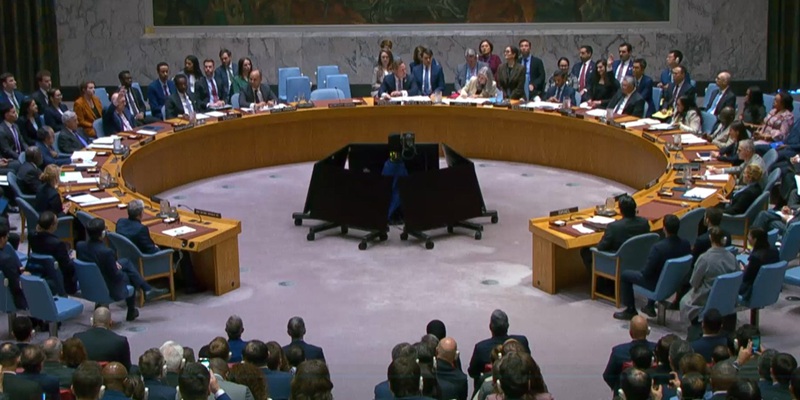
TDThe UN Security Council has adopted a Bahrain-led resolution demanding an immediate ceasefire in the Middle East.

Russia’s alternative draft resolution—though similar in calling for a halt to hostilities—placed stronger emphasis on condemning attacks against civilians and protecting infrastructure.
The Bahrain-led text passed with 13 votes in favor, none against, and 2 abstentions (China and Russia), while Russia’s draft failed to gain traction.
Breakdown of the Two Drafts
Bahrain-led Resolution (Adopted)
- Sponsors: Bahrain (on behalf of GCC + Jordan), with 85+ co-sponsors.
- Vote Outcome: 13 in favor, 0 against, 2 abstentions (China, Russia).
- Core Provisions:
- Immediate ceasefire across the region.
- Humanitarian access for civilians in Gaza, Lebanon, and other conflict zones.
- Call for restraint to prevent escalation and regional spillover.
- Framed largely around de-escalation and relief operations, without assigning blame.
Russia’s Alternative Draft (Not Adopted)
- Sponsors: Russia alone.
- Vote Outcome: Did not pass; overshadowed by Bahrain’s widely supported draft.
- Core Provisions:
- Immediate halt to military activities by all parties.
- Condemnation of attacks on civilians and civilian infrastructure in the strongest terms.
- Explicit call for protection of civilian populations under international humanitarian law.
- Urged parties to return to negotiations rather than unilateral military action.
- Differences from Bahrain’s Draft:
- Russia’s text was more legalistic, stressing obligations under international law.
- It highlighted civilian protection and condemned indiscriminate strikes, implicitly pointing at US-Israeli actions.
- Bahrain’s draft avoided direct blame, focusing instead on ceasefire and aid delivery.
Comparison Table
| Aspect | Bahrain-led Resolution | Russia’s Draft Resolution |
|---|---|---|
| Sponsorship | Bahrain (GCC + Jordan, 85+ co-sponsors) | Russia (solo) |
| Vote Outcome | Adopted (13–0–2) | Not adopted |
| Focus | Ceasefire, humanitarian aid, restraint | Civilian protection, condemnation of attacks |
| Tone | Neutral, de-escalatory | Legalistic, accusatory |
| Civilian Protection | Mentioned indirectly | Explicit, central to text |
| Political Backing | Broad Arab & global support | Limited, abstentions only |
China & Russia abstained on Bahrain’s resolution, arguing it lacked balance and ignored the root causes of escalation.
Russia’s draft was seen as too pointed against US-Israeli actions, making Western members unwilling to support it.
The adoption of Bahrain’s resolution reflects Arab consensus and global urgency for a ceasefire, but the abstentions highlight ongoing geopolitical divides.
Implications
The adopted resolution provides a framework for humanitarian relief and de-escalation, but its lack of accountability may limit enforcement.
Russia’s failed draft underscores the fractured Council politics, with Western states resisting language that could implicate US or Israeli military actions.
The abstentions suggest that future negotiations may hinge on addressing civilian protection more directly.
In summary, Bahrain’s resolution won broad support by focusing on ceasefire and aid.
Meanwhile, Russia’s alternative draft failed because it explicitly condemned attacks on civilians and leaned toward blaming US-Israeli actions.