
THIS DAWN — The recent expression of regret by Bishop Kukah over remarks widely interpreted as downplaying the persecution of Christians in Nigeria may have been heartfelt, but for many victims and observers it has arrived far too late.

In a nation awash with grief, displacement, and bloodshed, words spoken—or left unsaid—by moral leaders carry enormous weight.
When those words appear to diminish lived suffering, apologies, however eloquent, struggle to heal the wound.
How Bishop Kukah courted the bees
For weeks, Bishop Kukah was at the center of a storm following public comments questioning whether the violence faced by Christians in Nigeria amounts to genocide or systematic persecution.
His insistence that intent, not numbers, defines genocide; his skepticism over figures, citing thousands of destroyed churches; and his assertion that Nigeria’s crisis is not uniquely anti-Christian were interpreted by many as academic abstractions detached from the anguish of communities under siege.
The backlash was swift and fierce, particularly from northern and Middle Belt Christians who feel erased by such framing.
Now, in his December 9 statement, the Bishop of Sokoto says he is “deeply sorry” for the pain caused.
He insisted he never denied the persecution of Christians.
He speaks of misinterpretation, distraction, and the need to refocus on a collective “contest we must win.”
Yet the central issue remains unresolved: not whether Bishop Kukah intended to deny persecution, but whether his public interventions—timing, tone, and emphasis—served truth and justice in a moment of national trauma.
Moral clarity versus international law
Leadership in times of mass suffering is not primarily about semantic precision; it is about moral clarity.
While Bishop Kukah is correct that international law defines genocide by intent, not numbers alone, the insistence on legalistic thresholds in a pastoral context risks sounding evasive.
Communities whose churches have been razed, whose priests kidnapped or killed, whose women widowed and children displaced are not asking for a courtroom brief.
They are asking for recognition, solidarity, and advocacy.
The contrast repeatedly drawn between Bishop Kukah and Bishop Wilfred Anagbe of Makurdi is instructive.
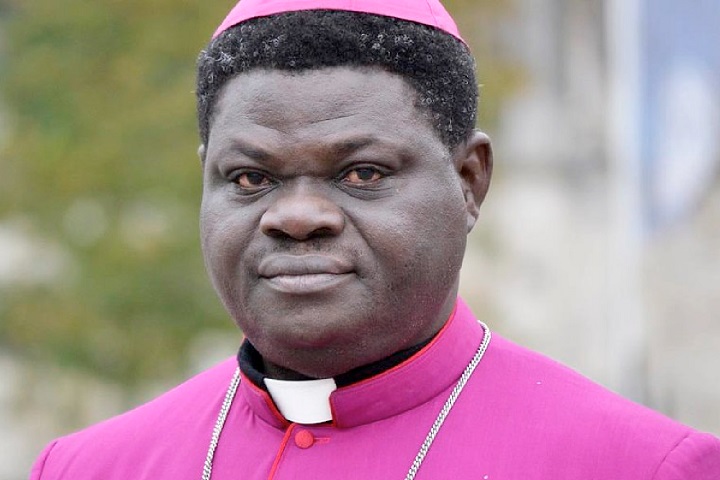
Bishop Anagbe, confronting the closure of parishes and mass displacement in Benue, has spoken plainly and urgently about a campaign of destruction targeting Christian communities.
One voice prioritizes caution and complexity; the other, proximity and clarity.
In a “wounded nation,” as Fr. Stan Chu Ilo aptly put it, the pulpit divided is not merely a theological problem—it is a pastoral failure.
“In which Nigeria?” Retorted Bishop Kukah
Bishop Kukah’s defenders argue that he has long acknowledged Nigeria’s security collapse and has warned of “floods of blood” without boundaries, noting that extremist violence now consumes Muslims as well.
This is true. Nigeria’s crisis is multi-layered, and simplistic binaries do not capture the whole.
Criminality, banditry, insurgency, and communal violence intersect in deadly ways.
But acknowledging complexity does not require minimizing patterns. Nor does calling for unity require flattening asymmetries of harm.
The Bishop’s challenge to statistics—asking “In which Nigeria?” when confronted with claims of churches burned—may appeal to scholarly rigor.
However, it rings hollow to those who know the names of villages emptied, dioceses hollowed out, and graveyards expanded.
Data collection in conflict zones is imperfect; the absence of perfect numbers is not the absence of reality.
When leaders with platforms emphasize uncertainty over urgency, they inadvertently shift the burden of proof onto the victims.
Too little, too late
There is also the matter of timing.
Bishop Kukah’s regret follows sustained public outrage and criticism from within the Church itself.
An apology offered after the damage is done does not erase the effect of earlier words amplified globally.
For persecuted communities, such reversals feel reactive rather than prophetic—prompted by pressure, not conviction.
Hence the refrain now echoing across pews and platforms: too little, too late.
This moment also raises a broader question about the role of religious leaders in international advocacy.
When speaking abroad, words can shape policy, influence aid, and frame global perception.
Minimization—intentional or not—can blunt urgency and slow response.
That is why survivors and advocates bristle when senior clerics appear to dilute the narrative at precisely the moment when clarity could mobilize action.
To be fair, Bishop Kukah is not without a path forward.
His statement gestures toward unity and solidarity; those must now be demonstrated, not merely declared.
Solidarity means centering the testimonies of those under fire, amplifying bishops and pastors closest to the killing fields, and using every available platform to press for protection, accountability, and relief.
It means acknowledging that while Nigeria’s violence is complex, certain communities are bearing a disproportionate burden—and naming that reality plainly.
Minimizing damages while graves multiply
History is unkind to equivocation in the face of atrocity.
The Church’s moral authority has always rested on its willingness to stand with the crucified of history, even when inconvenient.
If Bishop Kukah wishes to reclaim that authority, contrition must be followed by consistency: fewer caveats, more advocacy; less disputation over terms, more defense of lives.
Nigeria does not need another debate over definitions while graves multiply.
It needs voices that speak with the clarity of compassion and the courage of truth.
Bishop Kukah’s apology acknowledges pain; it does not yet repair trust.
Whether he moves from too little, too late to timely and true will determine how history remembers his witness in this dark chapter.