TDWas it meant to soothe a political constituency?

Was it a cultural signal?
Or was it yet another carefully staged moment where power speaks to power—while the people watch from a distance?
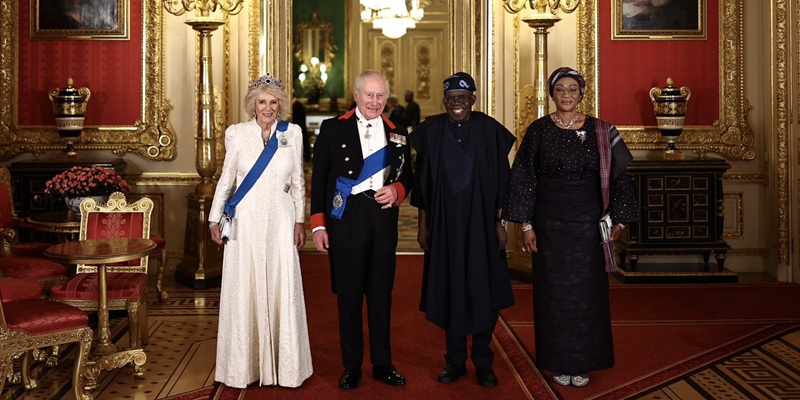
These are not cynical questions. They are the honest reflections of ordinary Nigerians listening to the speech delivered by King Charles III in honour of Bola Ahmed Tinubu and the First Lady at Windsor.
Because while the banquet hall echoed with poetry, humour, and cultural nods, another reality was unfolding—far from the chandeliers and carefully curated diplomacy.
Borno State was under fire.
Two Nigerias, One Moment
On one hand, there was celebration:
- Toasts to partnership
- Praises of Nigeria’s cultural influence
- References to Afrobeats, Nollywood, and economic ties
- Yoruba, Hausa, and Igbo proverbs woven into royal courtesy
On the other hand, there was mourning:
- Lives lost to terror
- Communities shattered
- Families thrown into grief
And between these two realities lies the discomfort that many Nigerians cannot ignore.
Because timing, in leadership, is not a minor detail—it is everything.

The Silence That Spoke Loudest
Diplomatic speeches are crafted. Every word is measured. Every omission is intentional.
Which is why the absence of any direct condolence to Nigeria, at a time when Borno State was experiencing fresh tragedy, feels not like oversight—but like distance.
Not emotional distance alone, but experiential distance.
It reinforces a long-standing perception:
That in the relationship between Britain and Nigeria, the language of partnership often floats above the lived reality of Nigerians.
And for a people who have borne the weight of history—colonial, political, and economic—that silence is not easily dismissed.
The Question of Representation
When Bola Ahmed Tinubu stood in that hall, who was he representing in that moment?
Was it:
The grieving families in Borno?
The displaced across the country?
The struggling citizens navigating economic hardship?
Or was it a version of Nigeria that is more acceptable to international diplomacy—polished, promising, and detached from its own pain?
Because representation is not about presence—it is about voice.
And when a nation bleeds, its leader must carry that reality into every room, no matter how grand.
Appeasement, Optics, or Strategy?
It is not unreasonable for Nigerians to ask difficult questions.
Was the timing of the visit influenced by internal political considerations?
Was it an attempt to balance religious optics during a sensitive national moment?
Was it a calculated diplomatic move?
Or is this simply how power operates—unmoved by the urgency of those outside its immediate circle?
These questions may not have immediate answers, but they arise from a place of lived experience.
Because for many Nigerians, engagements between British institutions and Nigerian leadership have historically felt elite-driven, people-detached, and consequence-light.
The Weight of History
To be clear, the speech by King Charles III acknowledged history—its pains, its shadows, its unfinished conversations.
But acknowledgment without alignment to present realities risks sounding ceremonial.
Nigeria is not just a story of potential.
It is a nation in tension:
Between growth and inequality
Between unity and fragmentation
Between global recognition and local suffering
And when these tensions are not reflected in moments of high diplomacy, the disconnect deepens.
The Ordinary Nigerian Perspective
For the average Nigerian, this is not about diplomatic language or royal etiquette.
It is about feeling seen.
It is about knowing that:
When tragedy strikes, it is acknowledged at the highest levels
When leaders travel, they carry the weight of their people’s reality
When partnerships are celebrated, they are grounded in mutual sensitivity
Instead, what many see is a recurring pattern:
Deals and dialogues at the top, while the bottom absorbs the consequences.
A Leadership Burden Unmet
President Bola Ahmed Tinubu had an opportunity—not just to attend a banquet, but to represent a wounded nation.
To subtly, but firmly, ensure that Nigeria’s current pain was not absent from the room.
Because diplomacy is not only about agreements—it is about advocacy.
And advocacy requires courage—the courage to introduce discomfort into comfort zones when necessary.
Beyond Symbolism
The danger of moments like this is not the event itself, but what it represents.
A growing gap between:
Leadership and lived reality
International image and domestic truth
Ceremonial partnership and practical empathy
If Nigeria must take its “rightful place” in global affairs, as often stated, then that place must be built not just on economic potential and cultural export—but on credible, grounded representation of its people’s reality.
Conclusion: The Question That Remains
So we return to the question:
Did we ask for this visit?
Perhaps not.
But more importantly:
Did this visit reflect us?
Did it carry the grief of Borno State into the halls of Windsor?
Did it speak for the displaced, the vulnerable, the unheard?
Did it align diplomacy with reality?
Or did it once again remind Nigerians that there are two conversations happening:
One among the powerful
Another among the people
Until those two conversations become one, moments like this—no matter how well-intentioned—will continue to leave behind a lingering discomfort.
Because a nation is not honoured by how it is toasted in foreign halls.
It is honoured by how its pain is acknowledged, wherever its leaders stand.