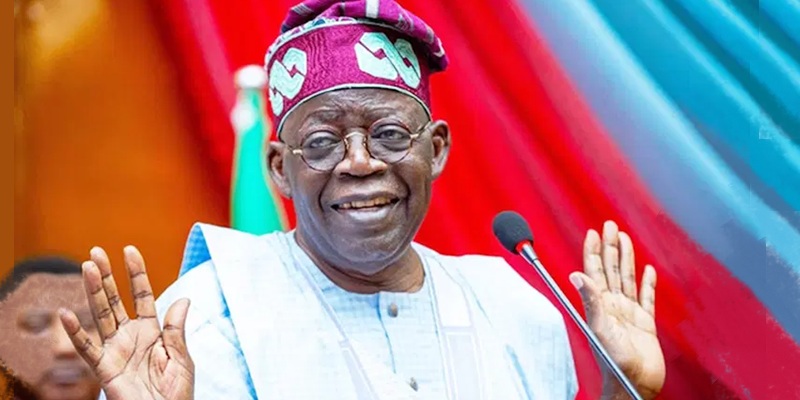

The All Progressives Grand Alliance (APGA) has formally announced that it will not field a presidential candidate in the upcoming 2027 general election, opting instead to adopt President Bola Ahmed Tinubu as its choice.
The declaration was made on Thursday by APGA’s National Chairman, Barrister Sylvester (Sly) Ezeokenwa, during a press briefing in Lagos.
APGA’s Position
Ezeokenwa explained that the party’s decision was informed by a strategic assessment of Nigeria’s political landscape.
He noted that APGA believes Tinubu’s leadership aligns with its vision for national development and stability.

By adopting Tinubu, APGA seeks to consolidate its influence and ensure that its structures contribute meaningfully to Nigeria’s democratic process.
The chairman also referenced recent amendments to the Electoral Act, particularly the provision for direct primaries.
He said the Electoral Act would strengthen grassroots participation and reduce the financial burden of internal party elections.
Implications for Nigeria’s Political Landscape
APGA’s decision marks a significant realignment in opposition politics.
Traditionally seen as a strong regional party with deep roots in the South East, APGA’s adoption of Tinubu signals a willingness to collaborate with the ruling All Progressives Congress (APC) at the national level.
For Tinubu, this endorsement adds symbolic weight to his coalition ahead of 2027, potentially broadening his appeal in regions where APGA maintains grassroots structures.
Analysts suggest that the move could reshape voter sentiment in the South East and reduce the number of opposition candidates, thereby narrowing the electoral field.
The Political Context
Nigeria’s political environment ahead of 2027 is witnessing increasing consolidation, with smaller parties either merging or adopting candidates from larger platforms.
APGA’s stance reflects the challenges faced by regional parties in mounting independent presidential campaigns in a system dominated by two major parties.
Ezeokenwa assured party members that APGA remains committed to its founding principles of justice, equity, and fairness.
He, meanwhile, emphasized that supporting Tinubu was the most pragmatic path forward.
APGA’s adoption of President Tinubu for the 2027 presidential election underscores a major political shift.
It strengthens Tinubu’s coalition while raising questions about the future of opposition politics in Nigeria.

Implications for Peter Obi
For Mr. Peter Obi, who relies heavily on South East solidarity and grassroots mobilisation, APGA’s decision presents both challenges and opportunities:
- Challenge to regional dominance: APGA’s endorsement of Tinubu could fragment South East votes.
That may significantly reduce Obi’s ability to consolidate the region as a political stronghold.
- Symbolic setback: APGA’s alignment with Tinubu undermines the narrative of a united opposition front in the South East.
That also may potentially weaken Obi’s bargaining power in national coalition politics.
- Opportunity for consolidation: On the other hand, APGA’s decision may galvanize Obi’s supporters, who could view the move as a betrayal of regional interests.
This could strengthen the African Democratic Congress (ADC)’s appeal as the true voice of opposition in the South East.
Broader Political Context
Nigeria’s 2027 election is shaping up to be a contest defined by alliances and realignments.
Smaller parties like APGA face increasing difficulty in mounting independent campaigns, often opting to align with larger platforms.
For Tinubu, APGA’s adoption is a strategic win.
For Obi, it is a reminder that his path to victory depends not only on regional loyalty but also on building broader national coalitions.