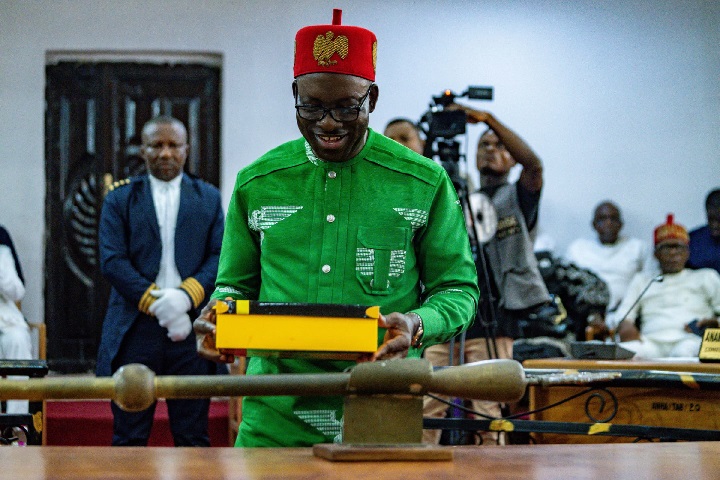
THIS DAWN — The unveiling of Governor Chukwuma Charles Soludo’s ₦757.9 billion “Changing Gears 3.0” 2026 Appropriation Bill has sparked strong reactions from policy experts and economic analysts, with many describing it as the administration’s most decisive move yet toward transforming Anambra State into a fully industrialised, innovation-driven economy.

Analysts argue that the budget—particularly its focus on administrative efficiency and economic expansion—marks a turning point in the state’s long-term development trajectory.
Presented on 25 November 2025, the budget proposes a capital-to-recurrent ratio of 79:21, underscoring what the Soludo administration calls an “infrastructure and productivity-first” approach.
But beyond headline figures, two components of the budget stand out: the restructuring of the Administrative Sector and the ambitious expansion of the Economic Sector, which enjoys a remarkable 26.7% year-on-year increase.
Administrative Sector: A Modest Increase with Strategic Intent
At first glance, the 12.2% increase allocated to the Administrative Sector might seem underwhelming.
However, analysts insist the figure reflects deeper structural changes already achieved since Soludo assumed office in 2022.
It could be noted that the administration had “ruthlessly cut the cost of governance to the bone,” eliminating ghost workers, collapsing inflated overheads, and digitalising processes that once crippled service delivery.
Key achievements—such as full digitalisation of land administration, transparent procurement enabled by technology, and Anambra’s consistent ranking as No. 1 in fiscal transparency—mean that the sector no longer requires the kind of heavy funding typical of bloated, analogue bureaucracies.
The 2026 budget therefore focuses on targeted efficiency improvements, including:
-
Full rollout of e-governance platforms across ministries
-
Near-100% biometric registration under the Anambra Resident Identity Management System
-
Strengthening the Bureau of Public Procurement
-
Completion of the permanent Secretariat Complex
-
Digital retrofitting of ministries and enhanced KPI-driven performance management
The Administrative Sector is now the “sharpened tool” that will accelerate execution of the capital-heavy budget.
Faster approvals, tech-enabled workflow, and reduced leakages are expected to improve investor confidence and support the development of Soludo’s flagship urban projects—Awka 2.0, Greater Niger, and the Aerotropolis.

Economic Sector: A 26.7% Jump to Ignite Industrial Transformation
The most significant component of the 2026 budget is the Economic Sector, which receives an explosive 26.7% funding boost.
This is the decisive financial trigger for the industrial revolution Soludo has envisioned under the Anambra Vision 2070 development plan.
After three years of groundwork—roads, security, urban reforms, utility upgrades—the state is now shifting from foundation-building to industrial take-off.
The expanded allocation will be channelled into five strategic pillars:
1. Anambra Mixed-Use Industrial City
This 5,000-hectare mega-city, designed for manufacturing, logistics, and agro-processing, will begin full-scale development in 2026.
Critical infrastructure—roads, power substations, digital fibre backbone—will be built to support heavy and light industries.
2. The Three New Cities: Awka 2.0, Greater Niger, and the Aerotropolis
These cities will move from blueprint to construction stage in 2026.
The Aerotropolis, leveraging the international airport, is expected to become the state’s biggest industrial-commercial hub in decades.
3. Solution Innovation District (SID)
The iconic tech campus will reach completion, with surrounding land allocated to private tech firms, startups, and R&D organisations.
SID’s venture fund and Angel Network will support innovation and youth employment.
4. Ease of Doing Business & Investment Promotion
An estimated ₦10–15 billion sub-head will fund investor roadshows, new incentive packages such as multi-year tax holidays, and the operational take-off of the revamped ANSIPPA investment agency.
5. Regenerative Agriculture & Export Value Chains
The budget expands Anambra’s agricultural drive—oil palm, coconut, bamboo, cashew, citrus—plus new processing zones, cold-chain logistics, and completion of the massive Oba Wholesale Drug & Medical Equipment Market.
Projected Impact: Jobs, Revenue, Diaspora Investment
Analysts predict that the combined projects—Industrial City, Tech District, and New Cities—will generate over 200,000 jobs between 2026 and 2030.
Manufacturing and innovation, currently at single-digit contribution to GDP, are projected to rise to 25–30% by 2030.
The state’s internal revenue (IGR), which stagnated for decades at ₦2–₦3 billion monthly, is expected to rise substantially due to new industries, property taxes in new cities, and expanded PAYE sources.
With modern infrastructure now emerging, many believe the Soludo administration is positioning Anambra to become a top-ten African sub-national economy by 2040.
Conclusion
One can conclude that the 2026 budget represents the moment Anambra “shifts gear from reform to transformation.”
If implemented faithfully, it could cement Soludo’s legacy—not just as a reformer, but as the governor who set Anambra on an irreversible path toward full industrialisation.
For Ndi Anambra, the message is clear: the future is not only bright—it has begun.