

TDThe African Democratic Congress (ADC) has been thrust into a storm of controversy following the denial of a certified resignation document attributed to Hon. Nafiu Bala, its Deputy National Chairman.

The document dated May 17, 2025, and later certified by the Independent National Electoral Commission (INEC) in October, confirms Bala’s departure from the party leadership.
More remarkable is the circumstances surrounding its disclosure and the political reverberations it has triggered.
It exposed deeper struggles within the ADC and raised questions about Nigeria’s electoral institutions.
The Document at the Heart of the Storm
The letter, signed by ADC National Chairman Ralph Okey Nwosu and National Secretary Alh. Said Baba Abdullahi, formally notifies INEC of Bala’s resignation.
It bears the official stamp of INEC headquarters in Abuja, marked “Certified True Copy” and signed by an Assistant Chief Legal Officer.
Handwritten notes indicate receipt of the document on August 13, 2025.
It signified that the commission had formally acknowledged the leadership change months before the certification.
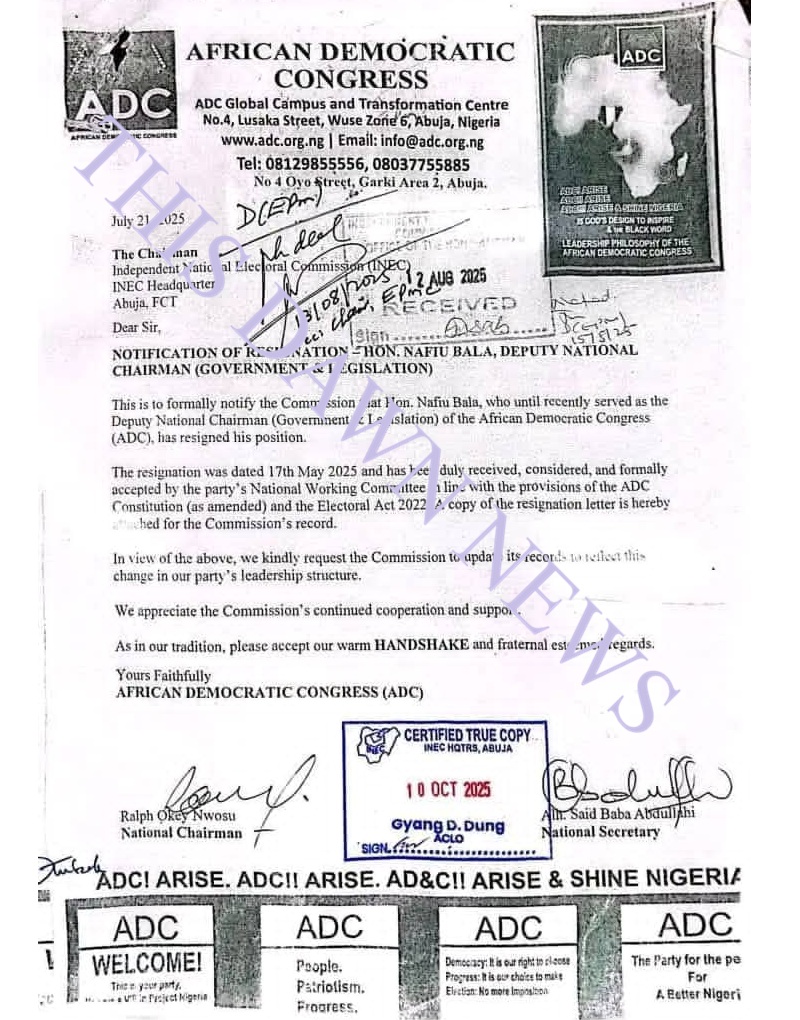
What makes the document explosive is not merely Bala’s resignation but the perception that the ADC deliberately withheld it from public view.
Critics argue that the party’s silence was strategic, designed to expose alleged collusion between INEC and ruling authorities.
The timing of its eventual surfacing has fueled speculation that the ADC sought to embarrass both President Bola Tinubu’s administration and the electoral umpire.
David Mark’s Struggles
Former Senate President David Mark, long regarded as a stabilizing figure in Nigeria’s political landscape, has found himself entangled in the ADC’s internal battles.
As chairman of the party, Mark’s influence as a statesman and his attempts to mediate disputes among opposition groups have been complicated by the Bala affair.
His calls for transparency and institutional integrity have clashed with the INEC’s opaque handling of the resignation letter.
Mark’s struggle is emblematic of a broader challenge facing elder statesmen in Nigeria: how to shepherd fragile opposition parties through crises.
INEC’s maneuvering has left him caught between advocating for democratic accountability and navigating the perception that he is against INEC or the ruling party.
Document Shows ADC’s Calculated Silence
The ADC’s decision to keep Bala’s resignation letter under wraps until late 2025 has drawn sharp criticism.
Party insiders suggest the leadership feared that publicizing the resignation earlier would weaken its bargaining power in coalition talks.
Others argue that the delay was tactical, aimed at exposing INEC’s alleged complicity in shielding ruling party interests.
The slogans emblazoned on the letterhead—“Democracy: It is our right to choose. Progress: It is our choice to make. Election: No more imposition”—now ring hollow to many observers.
For a party that brands itself as the “Party for the People,” the concealment of the document has seriously undermined INEC’s credibility.
INEC Under Fire
INEC’s role in certifying the resignation letter months after its receipt has raised eyebrows.
Critics question why the commission did not proactively disclose the leadership change, given its statutory duty to maintain accurate records of party executives.
The delay has fueled suspicions that INEC is deliberately shielding certain political interests, a charge the commission has consistently denied.
The controversy has reignited debates about the independence of Nigeria’s electoral body.
For opposition parties, the Bala letter is proof of systemic bias.
For INEC, it is a reminder of the delicate balance between administrative procedure and public perception.
The Broader Implications of the Document
The Bala resignation saga underscores the fragility of Nigeria’s opposition politics.
The ADC’s internal struggles highlight the difficulties smaller parties face in maintaining cohesion and credibility.
For David Mark and other elder statesmen, the episode illustrates the limits of moral suasion in a political environment where strategic silence and tactical disclosures often challenge transparency.
At the same time, the controversy on the document has broader implications for Nigeria’s democratic process.
Parties and institutions are seen to manipulate information for political gain, eroding public trust in the electoral system.
ADC’s move to weaponize Bala’s resignation against INEC and Tinubu may, it is hoped, succeed in sparking debate.
It has also exposed INEC’s own vulnerabilities.
Conclusion
The emergence of Nafiu Bala’s resignation letter is more than a bureaucratic formality—it is a political bombshell.
For the ADC, the document has become both a weapon and a liability.
For David Mark, it represents yet another test of his ability to navigate Nigeria’s turbulent political waters.
And for INEC, it is a reminder that even the smallest administrative detail can ignite a storm of controversy.
As the dust settles, one truth remains clear: in Nigeria’s politics, documents are never just pieces of paper.
They are instruments of power and symbols of credibility.
Sometimes, they are the spark that exposes the deepest struggles within parties and institutions.