THIS DAWN — In a rare and pointed commendation, the Editor in Chief of Al Jazeera’s Investigative Unit has praised the work of Diaspora Digital Media (DDM) for its fearless journalism and commitment to truth in the face of systemic intimidation.

The recognition came via email in response to a high-profile investigation into alleged existential threats made by Nigeria’s National Intelligence Agency (NIA) against Prof. Usman E.M. ASU, Lead Counsel in a decades-long international legal battle.
DDM Exposed Layers of Corruption
The Al Jazeera Investigative Unit has been conducting a deep-dive inquiry into Prof. Usman’s claims.
It acknowledged the critical role played by DDM in amplifying his voice and exposing the layers of corruption, forgery, and abuse surrounding the case.
The report was prepared by DDM’s former Editor-In-Chief, Mr. Tim Elombah.
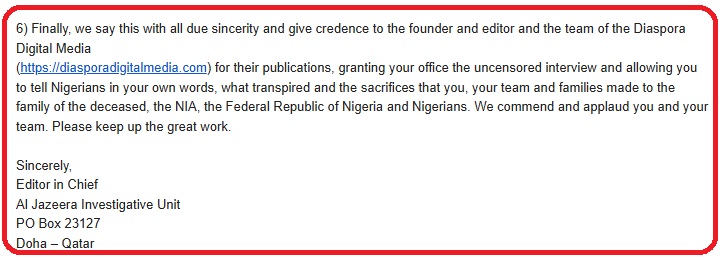
“We say this with all due sincerity and give credence to the founder and editor and the team of the Diaspora Digital Media for their publications,” the Editor in Chief wrote, “granting your office the uncensored interview and allowing you to tell Nigerians in your own words what transpired and the sacrifices that you, your team and families made.”
This endorsement not only validates DDM’s editorial integrity.
It also underscores the gravity of the allegations brought forth by Prof. Usman.
Usman’s legal representation of the Federal Republic of Nigeria in the Prague-based case of MUDr. Jiri Pasovsky has been marred by threats, unlawful detention, and financial sabotage.
A Legal Legacy Undermined
Prof. Usman’s letter to Al Jazeera, titled “Nigeria’s Intelligence Agency Existential Threats to my Life”, outlines a disturbing pattern of state-sponsored intimidation.
He served as Lead Counsel in the high-profile case of MUDr. Jiri Pasovsky (Case No. 45 T 21/2004), which began in February 2005 in Prague.
Pasovsky, an agent of the Czech Republic’s Security Information Service (BIS), was a counter-intelligence counterpart to Nigeria’s NIA.
Prof. Usman represented both the Nigerian government and the family of the deceased in the matter.
Despite his pivotal role, Prof. Usman alleged that the NIA has refused to pay his professional fees and incidental expenses for over two decades.
More alarmingly, he claims that in January 2025, he was unlawfully seized and incarcerated at the Keffi Correctional Center, only to be released in June.
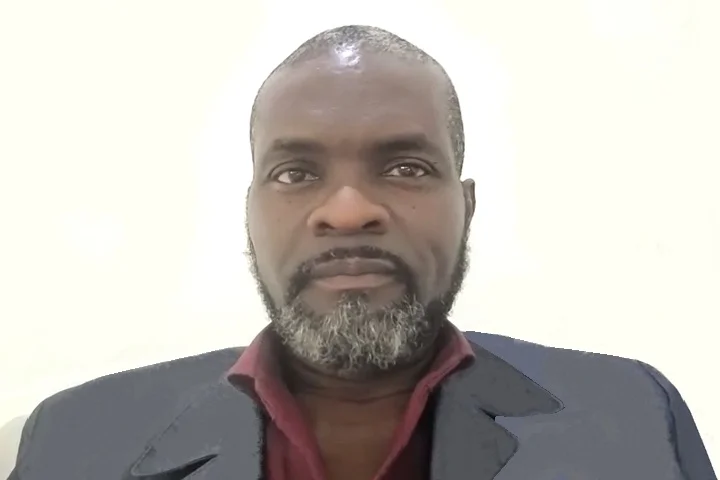
This detention, he argues, was orchestrated by state instrumentalities as retaliation for his persistent demands for payment and accountability.
According to Prof. Usman, senior officials within the Nigerian government demanded 90% of the $16+ million owed to him—an amount that continues to accrue monthly.
The consequences of these actions have been devastating.
The family of the deceased reportedly lost over $800,000 due to governmental negligence and obstruction.
Al Jazeera’s Investigative Findings
In its response, Al Jazeera’s Investigative Unit confirmed several of Prof. Usman’s claims.
The Unit stated that the NIA did indeed threaten him via telephone calls, a tactic known within the intelligence community as part of the agency’s modus operandi.
The Presidency, National Security Adviser (NSA), and Ministry of Justice were all aware of these threats, which were formally addressed to the Minister of Justice by the Chief of Staff to the President.
However, the investigation stalled at that point.
Al Jazeera further revealed that funds for Prof. Usman’s services were disbursed multiple times over the years.
Some were disbursed from the NIA and Ministry of Foreign Affairs, others from the Presidency and Ministry of Finance.
However, none were ever deposited into his accounts.
Forged Signatures, Diverted Payments
Instead, forged signatures were used to divert payments, often through Bureau De Change operators and offshore banks.
The Investigative Unit has traced these disbursements.
They also plan to publish the full amounts, account holders, and details of kickbacks received by officials who facilitated the fraud.
The Unit emphasized that the documents and evidence provided by Prof. Usman were instrumental in their investigation.
They described them as “very expensive” but “self-explanatory,” with some records dating back over two decades.
They advised that the findings could be used to file lawsuits in Nigeria or in international jurisdictions such as the U.S., UK, and EU.
Statutes of limitations may not apply to cases involving employment contracts, social security contributions, or professional services in such places.
The Role of DDM
At the heart of this unfolding story is the role played by Diaspora Digital Media, whose platform gave Prof. Usman the space to speak freely and truthfully.
In an era where state pressure often silences dissent, the outlet’s decision to publish an uncensored interview with the Lead Counsel was both courageous and consequential.
Al Jazeera’s commendation of Diaspora Digital Media is a testament to the power of independent journalism.
“We commend and applaud you and your team,” the Editor in Chief wrote, “Please keep up the great work.”
See a screenshot of the commendation below:
This recognition places the outlet among a growing cadre of media organizations committed to exposing corruption and defending democratic values.
Implications for Nigeria
The revelations from Al Jazeera’s investigation and the supporting coverage by Diaspora Digital Media have far-reaching implications.
They raise serious questions about the integrity of Nigeria’s intelligence agencies, the accountability of its financial institutions, and the protection of legal professionals who serve the state.
Moreover, the case highlights the importance of international media partnerships in uncovering hidden truths.
Watch the uncensored interview below: