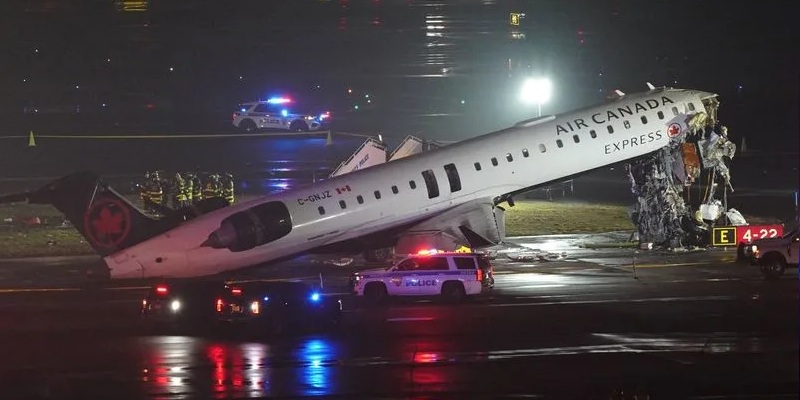
TDA devastating late-night collision at LaGuardia Airport has claimed the lives of two crew members and left dozens injured after an Air Canada Express passenger jet struck a fire truck on the runway.

The incident has plunged one of America’s busiest airports into chaos and raised urgent questions about aviation safety protocols.
What Happened
- At approximately 11:40 p.m. Sunday, Jazz Aviation Flight 8646, operating on behalf of Air Canada, collided with a Port Authority aircraft rescue and firefighting vehicle on Runway 4.
- The aircraft, a Bombardier CRJ-900 twin-jet, was completing its landing sequence at about 30 mph when the collision occurred.
- The pilot and co-pilot were killed instantly in the impact, their cockpit crushed by the force of the collision.
- The flight carried 72 passengers and 4 crew members from Montreal to New York.
- More than a dozen passengers sustained injuries, ranging from fractures to concussions, with some requiring urgent medical attention.
- Victims were rushed to Elmhurst Hospital and Queens Presbyterian Hospital, where emergency teams worked through the night.
- Two Port Authority police officers aboard the firefighting vehicle suffered broken limbs but remain in stable condition.
Investigations Underway
The Federal Aviation Administration (FAA) confirmed the accident and immediately grounded operations at LaGuardia.
The National Transportation Safety Board (NTSB) dispatched a “go team” to the site, tasked with reconstructing the sequence of events and identifying lapses in communication or procedure.
Investigators are focusing on how the firefighting truck entered the runway during an active landing.
Aviation experts say the breach should have been prevented by ground control systems.
Eyewitness Accounts
Passengers described a terrifying scene as the plane jolted violently upon impact.
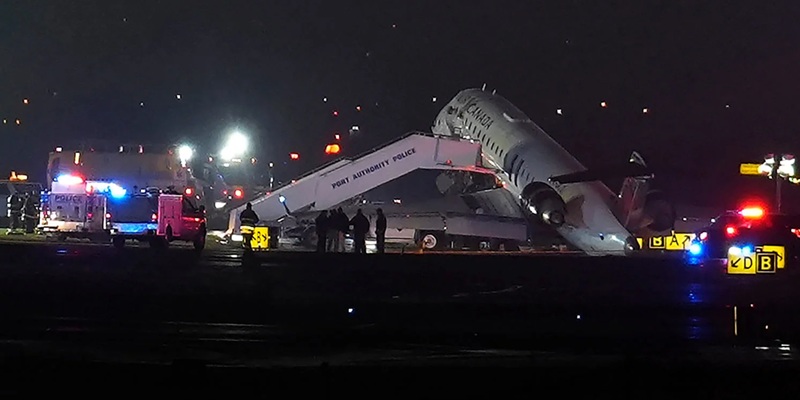
Video circulating on social media shows the jet’s forward fuselage mangled, its nose pressed into the tarmac, with emergency responders swarming the wreckage.
Some passengers were seen limping away, supported by fellow travelers, while others were carried on stretchers.
LaGuardia Airport was immediately closed following the crash.
The FAA announced that flights will remain suspended until at least 2 p.m. Monday, disrupting thousands of travelers across the region.
The NYPD urged residents to avoid the area, noting that all streets and highway exits into the airport are sealed off to allow emergency operations.
Broader Implications
This tragedy has reignited debate over runway safety and coordination protocols at major airports.
Aviation analysts point out that while runway incursions are rare, they remain one of the most dangerous scenarios in aviation, often leaving little margin for error.
The collision underscores vulnerabilities in communication between air traffic control, ground operations, and emergency responders.
With LaGuardia serving as a critical hub for domestic and international travel, the incident is expected to prompt a sweeping review of safety measures across U.S. airports.
Global Attention
The deaths of the pilot and co-pilot—both Canadian nationals—have drawn international attention, with Air Canada pledging full cooperation in the investigation.
Families of the victims, passengers, and crew now await answers on how such a catastrophic breach of safety could occur at one of the busiest airports in the United States.
As the investigation unfolds, the tragedy at LaGuardia may well become a turning point in the push for stricter runway incursion prevention systems.
It will expectedly ensure that no emergency vehicle or aircraft ever shares the same space at the wrong time again.