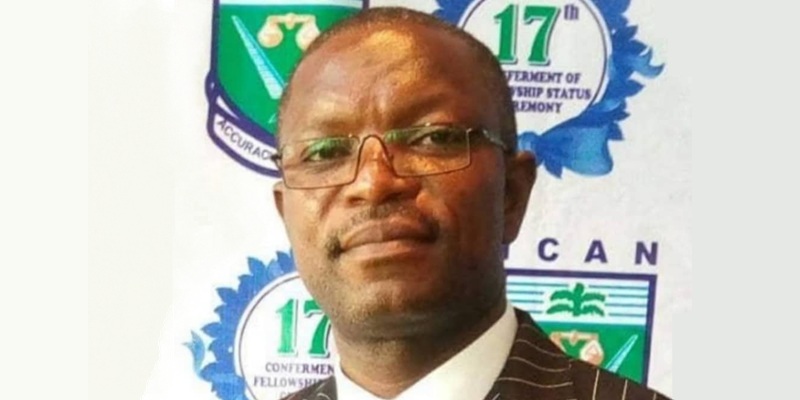
TDA Nigerian whistleblower’s sour-sweet situation: recognition abroad while struggling at home.

Darkness has a peculiar habit. It rarely travels alone. It gathers allies. Silence. Fear. Complicity. Soon enough, a crowd forms around the shadows, and before long the darkness begins to look normal.
Nigeria, it has to be said, has developed an unfortunate genius for this arrangement. And sadly, darkness is not a metaphor in these parts.
It is too much with us for even the bravest poets to try to evoke in stanzas foreboding doom. We have perfected systems that put out the lights for wrongdoing to pass unnoticed, and for the public to grow accustomed to the gloom.
Which is why the story of Yisa Usman matters.
Not merely because he has been honoured. Not even because the honour came from far beyond our shores.
His story matters because in a landscape that has grown comfortable with darkness, both the metaphorical and the lived reality, he has insisted on remaining visible. Bright, inconvenient, and stubbornly lit.
To understand the moment properly, we must travel now, at least in the imagination, to Berlin.
There, last month, an independent international jury gathered to confer the 2026 Ellsberg Whistleblower Award.
The Award was named after the American truth teller who exposed the Pentagon Papers and reminded the world that governments are not always reliable narrators of their own conduct.
The award celebrates individuals whose actions “significantly enhance public debate, strengthen the public’s right to know, and advance democratic accountability”.
This year’s prize, which includes €10,000, went to Andrés Olarte Peña, a Colombian environmental whistleblower whose actions brought hidden ecological wrongdoing into the light.
The runner up, the man who came closest to that coveted recognition, was a Nigerian.
Yisa Usman. Former Deputy Director of the Joint Admissions and Matriculation Board (JAMB). Whistleblower.
There was, and this is another thing that must be said, a quiet irony in the celebration. When the applause sounded in Berlin, the man being applauded could not be there to hear it.
He was in Nigeria, unable to travel.
If this were fiction, an editor might suggest toning down the symbolism. It would feel too deliberate, the editor might say.
Too neatly arranged. Verging on hyperbole, if not melodrama. Yet reality sometimes conjures what even the most daring of writers get talked out of.
So here was a man being recognised at a global level for exposing “systemic violations of public financial management rules and recruitment procedures within JAMB”.
The jury praised his courage.
They acknowledged that his disclosures “constituted a significant contribution to the public interest and helped stimulate national debate on corruption, governance reform and the urgent need for effective whistleblower protection in Nigeria”.
And where was the subject of this global commendation?
Not on the stage. Not in the audience. Not even quietly observing from the back of the room.
He was at home in Nigeria, navigating the unfortunate consequences of his honesty.
In a better ordered world, recognition of this sort would close the story with a sense of justice restored. In our own complicated reality, it merely sharpens the contrast between what is celebrated abroad and what is endured at home.
For choosing integrity over silence, Yisa Usman has paid the price that whistleblowers in fragile systems often pay. He has faced dismissal from public service. He has endured prolonged legal battles.
His passport was seized, and the delay by the authorities in returning that important travel document is a major reason he was not in Berlin.
There have been threats directed at him and his family. Opportunities that should ordinarily accompany international recognition remain out of reach.
The jury in Berlin did not ignore these facts. On the contrary, they treated them as central to the story.
Courage is not measured in comfortable circumstances. It reveals itself when the personal cost becomes unavoidable.
And now this entire matter invites a deeper national reflection.
A whistleblower is not an irritant to governance. As the African Centre for Media and Information Literacy put it in a statement welcoming Yisa Usman’s recognition, “the whistleblower is not an inconvenience to governance; he is its essential early warning system”.
Any system that wishes to function properly must possess internal alarms. In engineering terms, these are early warning signals that something has gone wrong before the entire structure collapses.
Think of the little red lights on the dashboard of your car. They alert you that something is wrong. Remove those signals, silence those alarms, and the system may appear stable for a while. But the collapse, when it comes, will be sudden and complete.
Countries that have taken corruption seriously understand this simple truth. They build legal protections around those who expose wrongdoing. They recognise that the messenger is not the enemy of order but its quiet defender.
Senegal, for example, passed a whistleblower protection law in August 2025, becoming the first French-speaking sub-Saharan African country to establish a comprehensive legal framework to ensure the safety and rights of individuals who expose matters of public interest.
Our English-speaking West African neighbour, Ghana, passed a Whistleblower Act in 2006 and strengthened its provisions through an amendment in 2023.
Nigeria has spoken often about this principle. Acting upon it has proved more difficult.
Back in July 2017, the Nigerian Senate passed the Whistleblower Protection Bill. Senator David Umaru, who sponsored the bill, said at the time that it would “ensure adequate protection of whistleblowers from reprisals, victimisation, isolation and humiliation, which were some of the consequences of whistleblowing”.
The Senate President at the time, Bukola Saraki, called it “a landmark achievement in the course of fighting corruption in the country”.
That was nearly nine years ago.
Discussions have followed in the House of Representatives. Committees have committed. Experts have weighed in. Civil society organisations have repeatedly sounded the alarm.
Still the legislation remains unfinished business.
Meanwhile, the unintended message travels swiftly through the national bloodstream. Anyone contemplating the difficult decision to expose wrongdoing is forced to pause and calculate the risks.
The lesson, unfortunately, appears straightforward. Recognition may come from distant lands. The consequences will be borne at home.
That calculation is precisely what weakens anti-corruption efforts everywhere. When the price of truth telling becomes unbearable, silence begins to look like prudence.
Yet history also teaches another lesson. Darkness, however confident it may appear, possesses a fatal weakness.
It cannot extinguish a light that refuses to go out.
A single candle does not transform the entire room. It does not rival the sun. It does something far simpler and, in its own way, more profound. It proves that illumination is possible.
That is the quiet symbolism surrounding Yisa Usman today.
His story is not yet one of triumph. His legal challenges are ongoing. His professional life has been disrupted. His freedom to travel remains restricted. In strictly personal terms, the struggle continues.
But the light remains.
The jury that recognised him understood this instinctively. It is worth reiterating that they described his disclosures as a significant contribution to the public interest.
They acknowledged that his actions stimulated national debate on corruption and governance reform.
In awarding him the runner up honour, which it must be stated clearly did not come with any monetary prize, they affirmed a simple truth that every society eventually confronts. Courage of this kind is rare, and when it appears it deserves protection.
Which now brings us to the unfinished task before Nigeria.
The Whistleblower Protection Bill must move beyond discussion and become law. Not as a symbolic gesture. Not as a concession to civil society advocacy. But as a practical instrument for strengthening governance itself.
When individuals inside institutions know that the law stands behind them, wrongdoing loses one of its most reliable shields. When those who speak out are protected rather than punished, the culture of silence begins to fracture.
Nigeria does not need fewer whistleblowers. It needs more of them. What it requires is the legal architecture that allows them to act without destroying their lives in the process.
And the public must recognise something that is often lost in the political noise. A whistleblower is not a saboteur of institutions. He is, in many cases, the last loyalist within them.
The person who exposes corruption or any other form of wrongdoing in the public interest is rarely the one who damaged the system. More often, he is the one trying to save it.
Until that understanding takes deeper root, Nigeria will continue to occupy the peculiar position of exporting courage while importing recognition for it.
For now, the image remains a simple one.
Yisa Usman. In Nigeria. Unable to travel. Unable to fully access the opportunities that international recognition should ordinarily open.
But still standing.
Still speaking.
Still lit.
A single candle in the dark.
And anyone who has ever stepped into a room without light knows exactly where the eye goes first.
Not to the darkness.
Not to the shadows.
But to the candle.
Every single time.
One day, Nigeria will pass the law that protects those who carry such light. One day, the country will realise that the war against corruption cannot be won by sacrificing the first people brave enough to fight it.
When that day arrives, the applause will not need to travel all the way from Berlin.
Until then, one candle continues to burn.
And darkness, however vast it may appear, has never quite learned how to defeat a single candle in the dark.
Crispin Oduobuk is a Senior Programme Officer for Policy and Advocacy at the African Centre for Media and Information Literacy (AFRICMIL).