TDThe Nigerian judiciary finds itself at another precarious crossroads, where the lines between accountability, persecution, and institutional independence have become dangerously blurred.

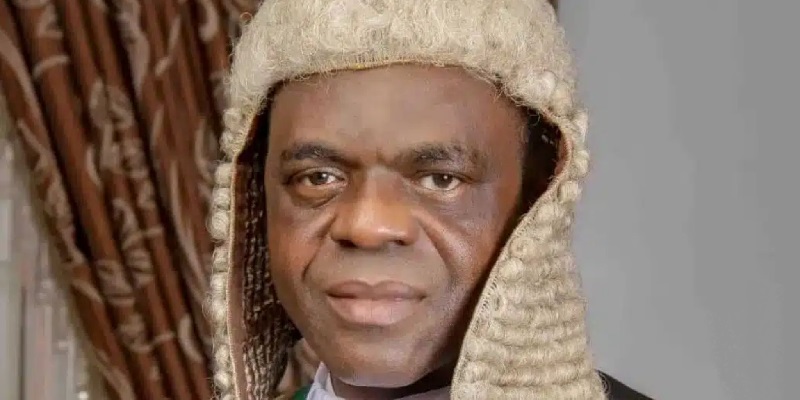
Justice John Tsoho, Chief Judge of the Federal High Court, is simultaneously the subject of a Code of Conduct Bureau (CCB) investigation over alleged undeclared accounts.
He was also the recipient of an explosive petition from the Economic and Financial Crimes Commission (EFCC) seeking the removal of Justice Mohammed Umar from a high-profile terrorism financing case.
This convergence of circumstances raises an uncomfortable but unavoidable question:
Can a Chief Judge facing serious personal allegations independently and fairly adjudicate petitions that carry profound implications for the government’s prosecutorial agenda?
The Tsoho Investigation: A Cloud Over the Bench
The CCB’s summons of Justice Tsoho stems from allegations that he failed to declare four bank accounts—three with United Bank for Africa (UBA) and one with Access Bank—in his asset declaration form submitted in April 2024.
There are also claims of age falsification.
If found guilty, the consequences are severe: removal from office, forfeiture of undeclared assets, and a 10-year ban from public office.
After initially failing to honor the CCB’s invitations, Justice Tsoho has now retained former Attorney-General Kanu Agabi (SAN) and indicated his willingness to appear before the Bureau the week of March 16, 2026 .
The Federal High Court has issued statements emphasizing his commitment to cooperation, transparency, and due process.
However, the Nigerian Bar Association (NBA) has strongly condemned the CCB’s action, citing the Supreme Court’s decision in FRN v. Nganjiwa.
The judgement established that the National Judicial Council (NJC) must exercise disciplinary control over serving judicial officers before any criminal or quasi-criminal proceedings can commence.
The NBA warns that allowing the CCB to independently summon a serving Chief Judge constitutes an unconstitutional encroachment on judicial independence and the doctrine of separation of powers.
The EFCC Petition: A Test of Impartiality
While Justice Tsoho navigates his own legal troubles, he holds in his hands the fate of another judge—Justice Mohammed Umar—who is presiding over a sensitive terrorism financing case.
The case involves Bauchi State Commissioner for Finance Yakubu Adamu, Miyetti Allah leader Bello Bodejo, and others accused of laundering approximately $9.7 million.
The EFCC’s petition to Justice Tsoho seeks Justice Umar’s disqualification, alleging loss of confidence after he granted bail to the defendants—bail that had previously been denied by Justice Emeka Nwite.
The anti-graft agency argues that granting bail despite “the weight and gravity of the allegations” undermines confidence in Justice Umar’s ability to guarantee fairness.
Justice Umar has temporarily stepped aside pending the Chief Judge’s decision.
The Independence Question
This is where the situation becomes deeply problematic.
The EFCC, an agency of the executive branch, has petitioned a Chief Judge who is himself under investigation by another executive body (the CCB).
The Commission wants a judge removed from a case involving alleged terrorism financing—precisely the type of national security matter that governments typically want to control tightly.
Can Justice Tsoho, looking over his shoulder at the CCB investigation that could end his career, make an entirely independent decision on the EFCC’s petition?
Would any decision he makes—whether to remove Justice Umar or allow him to continue—be free from the suspicion that he is either currying favor with the executive or overcompensating to prove his independence?
The timing is exquisitely uncomfortable.
As the CCB investigation looms, the NJC is reportedly under pressure from the Chief Justice of Nigeria to act, and the EFCC’s petition demands resolution.
Justice Tsoho must weigh whether the EFCC’s “loss of confidence” in Justice Umar constitutes a valid ground for reassignment or whether it represents executive overreach into judicial discretion.
The Larger Pattern
This saga echoes Nigeria’s unfortunate tradition of using accountability mechanisms as political tools.
The 2019 prosecution of former Chief Justice Walter Onnoghen by the CCB—which the NBA also opposed on jurisdictional grounds—set a troubling precedent.
Now, a similar script is playing out, with the added twist of an EFCC petition landing on the desk of a besieged Chief Judge.
As one senior lawyer anonymously noted, the handling of Justice Tsoho’s case will test the CJN’s promise to “clean up the judiciary”.
But the more immediate test is whether Justice Tsoho can demonstrate that judicial independence is not merely a constitutional abstraction but a living principle that can withstand pressure from all sides.
Conclusion
Let no one be naive: Justice Tsoho is not necessarily a saint, and the allegations against him deserve thorough investigation through the proper constitutional channels—namely, the NJC.
But neither are the institutions pressuring him motivated purely by zeal.
The EFCC, the CCB, and the executive they serve have their own interests, their own prosecutorial agendas, and their own political calculations.
To assume that a Chief Judge under investigation can coolly and impartially decide a petition that aligns perfectly with the government’s apparent desire to control judicial outcomes may be expecting too much of human nature.
The system has placed Justice Tsoho in an impossible position: damned if he rules against the EFCC and invites further scrutiny, damned if he rules for it and confirms every suspicion about judicial subservience.
As with the El-Rufai matter, the wise observer will watch how this plays out—not with expectations of pristine justice, but with eyes wide open to the fluid, unpredictable, and deeply political nature of Nigeria’s legal battles.
The independence of the judiciary hangs in the balance, but so too does the reputation of a Chief Judge who must now prove he can be both accountable and independent simultaneously.