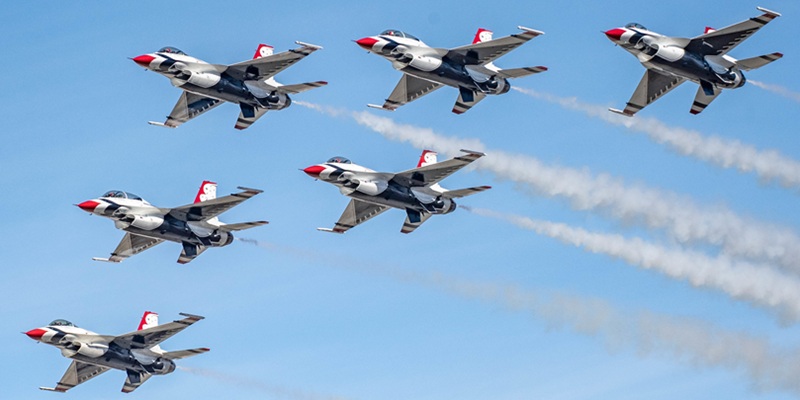
Reports indicate that 48 United States Air Force fighter jets are mobilizing, with flight paths suggesting they may be en route to the Middle East.

The deployment comes amid heightened tensions in the region, where U.S. military presence has often been a stabilizing but controversial factor.
Large-scale movements of this nature typically signal preparation for either deterrence operations, joint exercises with allies, or potential combat readiness in response to emerging threats.
Implications
- Regional Security: The arrival of such a significant air fleet could reshape the balance of power and send a strong message to adversaries.
- Diplomatic Fallout: Allies may welcome the reinforcement, but critics could view it as an escalation.
- Operational Readiness: Mobilizing 48 jets simultaneously underscores the scale of U.S. military capacity and its ability to project power quickly.
International observers are already on the watchout for the following:
- Official Pentagon statements clarifying the mission.
- Reactions from Middle Eastern governments and regional blocs.
- Potential impact on ongoing diplomatic negotiations in hotspots such as Iraq, Syria, and the Gulf.
Comparative Analysis: U.S. Air Deployments to the Middle East
Historical Patterns
- 1990–91 Gulf War: The U.S. deployed hundreds of fighter jets to Saudi Arabia and Kuwait in preparation for Operation Desert Storm.
- 2003 Iraq War: Large-scale deployments of F-15s, F-16s, and F/A-18s supported the invasion and subsequent operations.
- 2014–2017 ISIS Campaign: Dozens of jets were stationed in Qatar, Kuwait, and Jordan to conduct airstrikes against ISIS targets.
- 2020s: Rotational deployments continued, often involving smaller squadrons of 12–24 jets, primarily for deterrence and joint exercises with allies.
Current Movement – 48 Fighter Jets
- Scale: Mobilizing 48 jets simultaneously is significant, suggesting either a major exercise or preparation for heightened regional tensions.
- Comparison: While not as large as Gulf War deployments, this movement is far greater than typical rotational squadrons, indicating a more serious operational posture.
- Implications:
- Could be aimed at reinforcing U.S. bases in Qatar, Bahrain, or the UAE.
- May serve as a deterrent against adversaries like Iran or militant groups.
- Signals to allies that Washington is committed to regional security.
This deployment fits into a long tradition of U.S. air power projection in the Middle East.
However, the scale (48 jets) places it closer to crisis-response levels than routine rotations.
This may suggest that Washington is preparing for a scenario that requires rapid escalation capability.
Regional Impact Forecast: U.S. Fighter Jet Deployment
Iran
- Likely to interpret the movement of 48 U.S. Air Force jets as a direct show of force.
- Could respond with heightened rhetoric, military drills, or proxy activity in Iraq, Syria, or Yemen.
- Deployment may complicate ongoing nuclear negotiations.
Israel
- Will welcome the reinforcement as a signal of U.S. commitment to regional security.
- May coordinate intelligence and operational planning with Washington, especially if tensions with Iran escalate.
Saudi Arabia & Gulf States (UAE, Qatar, Bahrain)
- Likely to see the deployment as reassurance of U.S. protection against regional threats.
- Could leverage the presence to strengthen their own deterrence posture.
- May also use it to justify closer military cooperation with Washington.
Iraq & Syria
- Governments and militias may view the deployment as preparation for potential strikes or deterrence against insurgent activity.
- Could trigger warnings from groups aligned with Iran, raising the risk of clashes.
Global Implications
- Energy Markets: Oil prices may react to perceived instability in the Gulf.
- Diplomatic Fallout: Russia and China may criticize the move as escalation, while NATO allies could quietly support it.
- Military Readiness: The scale of the deployment signals Washington’s intent to maintain rapid escalation capability in the region.
This forecast shows how each major player in the Middle East is likely to interpret the deployment, underscoring its potential to reshape both security dynamics and diplomatic relations.